

Sacramento Street Psychiatry

Efficacy of dynamic psychotherapy

unique flowerThe following post is an adaptation of an argument I presented on Sacramento Street Psychiatry, my blog on the Psychology Today website.  As usual, I welcome your comments. Western medicine's great strides are largely due to understanding etiology (the biological basis of disease), defining a nosology (a system of categorizing diseases), and testing treatments aimed at these nosological entities, not at individual patients. Take 100 healthy volunteers, swab their throats with Streptococcus, and perhaps 88 will soon develop strep throat. Both our knowledge of bacterial infections (etiology) as well as repeated empirical observation of similar cases leads us to conclude that Streptococcus causes a recognizable condition called strep throat (nosology). Once patients are diagnosed with strep throat — once their conditions become exemplars of this disease category — experiments can be done to show which treatments relieve the condition. Western medicine is the accretion of such knowledge.

Hypotheses about disease categories, and about treatments aimed at these categories, can be tested using randomized controlled trials (RCTs), our most powerful statistical method to assess the effect of independent variables. As in the rest of medicine, evidence supporting the efficacy of psychopharmacology, as well as manualized psychotherapies such as CBT, depends on sorting patients into nosological categories such as "major depression," applying different treatments to comparison groups, and finding statistically significant group mean differences.  In psychology such a research approach is called nomothetic; the goal is to identify general laws of behavior.

However, another kind of knowledge is important too. Why didn't the other 12 subjects get strep throat? Is it the same reason for all 12, or is the answer different for each of them? Looking at what makes people unique, as opposed to members of a category, is called idiographic research in psychology. This is the nature of psychodynamic theory and treatment, and why it resists the usual RCT approach to research. Patients who present for such treatment rarely fit neatly into a category such as "depressed." They vaguely say their lives aren't working well for them, or that their relationships are unsatisfying in a particular way. They lack meaning and purpose in life.  They get a "funny feeling" when dealing with competition. Their boss triggers authority issues.  They can't trust their spouse's fidelity. And on and on.  Such complaints are not exemplars of a nosological category. We may not know what causes schizophrenia or bipolar disorder — we have no etiological understanding of any psychiatric disorder, one reason they are called "disorders" and not "diseases" — but at least these labels reflect a coherent nosology.  Not so with the presenting complaints of most psychotherapy patients.

Psychodynamic therapists and psychoanalysts find little of value in the nomothetic approach. DSM-IV and similar nosology sheds no light on the particular patient in the office, with his unique history, dreams, fears, hopes, etc. The psychoanalytic/dynamic perspective is to understand the uniqueness of that specific patient, and to promote unique helpful changes that may have no relevance to any other patient seen in the practice.

This is not to discount the importance of the nomothetic approach where it applies. If a patient's condition is exemplary of a nosological category, it should be treated that way.  Doing so allows us to use powerful research tools to separate bias and wishful thinking from real treatment effects.  If a patient presents with major depression, bipolar disorder, or schizophrenia, nomothetic research can and should guide treatment. In such cases, psychodynamic therapy must stand or fall on the same RCT basis as other treatments.  The evidence base for manualized psychotherapies such as CBT, IPT, and a few others is stronger than for dynamic psychotherapy. If someone is seeking relief of major depression, pure and simple, I am happy to refer them to a CBT therapist, and have done so on a number of occasions.  It would be nice to be able to claim strong evidence for the efficacy of prescription antidepressants as well, but unfortunately this is less clear.

CBT and other manualized therapies for specific conditions are much easier to study than dynamic therapy for ill-defined complaints. So it's really no surprise there are more such studies.  Idiographic research methods, e.g., pre and post measures in single-case designs, have been used to study dynamic psychotherapy, both whether it works and how. But nomothetic researchers consider this "weak science": There are no control groups — no groups at all, actually.

The bottom line is that dynamic psychotherapy has different goals than CBT or medication.  It doesn't aim to treat a nosological category such as major depression.  Since it isn't based on a nomothetic treatment model, RCTs are the wrong assessment tools to use.  Idiographic research methods may be statistically weaker than their nomothetic counterparts, but they are the best that this domain of inquiry allows.  (Seligman argues that naturalistic surveys have their place too.)  Dynamic psychotherapy is based on a rich theoretical foundation that has been scrutinized and refined for the past century. But ultimately it comes down to the individual and the unique mix of discomforting feelings and troubling thoughts that led him or her to reach out for help.

If I accused you of being a Martian...

Cross-posted from "Sacramento Street Psychiatry". In dynamic psychotherapy, patients often say how hurt and victimized they feel as a result of unkind judgments or criticisms by others:

"My coworker called me a hypocrite!"

"My mother told me I neglect her by not visiting enough."

"My husband complains I'm too self-centered."

Although sharing such complaints with a caring listener is basic human nature, in therapy it is also recognized as a defense mechanism called externalization. A fundamental tenet of psychotherapy is that change comes from within. The hurtful coworker, mother, or husband is not present in the room, and cannot be influenced directly by the discussion. It is the patient's reaction that can be examined and perhaps modified.

I tend gently to move things along in therapy, as opposed to letting them unfold at their own pace. I often question this in myself, sometimes wondering if I am too results-oriented. On balance, though, I believe it saves time, money, and tedium for both of us if I focus on issues that can actually make a difference. With this in mind, I don't let externalizations just sit there. I playfully illustrate how harsh judgments only sting if the patient accepts or endorses them at some level: The hurt is really self-criticism, and the solution is really a new self-appraisal.

If I accuse you of being a dirty rotten Martian, it isn't apt to have much impact. You may question my sanity, but you are not put on the defensive or moved to offer a spirited rebuttal. Nor do you engage in sober soul-searching to assure yourself I'm mistaken. You already know you are not a Martian, so the putdown rolls off your back.

In contrast, what if I accuse you of being selfish? This charge is harder to dismiss. We are all selfish to some degree; it's a judgment call where to draw the line between self-interest on the one hand and self-sacrifice on the other. Moreover, as Sigmund Freud describes in Civilization and its Discontents, humans are able to live together in society because we repress many self-gratifying urges into the unconscious. We are, in other words, more selfish (and narcissistic, and greedy, and hypocritical, and childish...) than we like to think.

The criticisms that sting are the ones that stir up our own self-doubts. Maybe we are hypocritical, neglectful, self-centered. Perhaps our shameful defect has been exposed. This is what calls up anxiety, reactive anger, and defensiveness.

Such self-criticism is unpleasant when made conscious in therapy. Yet this is the path toward change. For the problem is not in the external world after all. It resides in the mind of the person in the therapy room, a person who now more clearly sees where his or her troubling feelings originate.

I really do use the Martian example all the time in my work with patients. It's a thing of joy to watch how something so apparently frivolous can shift the focus from unhelpful externalization to honest insight.

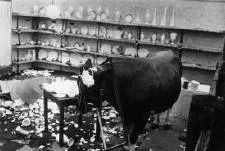
Bull in a china shop

Reposted from Sacramento Street Psychiatry. Sometimes an unruly character disrupts the surrounding peace and quiet.  Loud, gruff words and ill-considered behavior mar the scene.  Onlookers cringe, awaiting the impending destruction.  For this beastly fellow is bound to break something: wreck a friendship or relationship, make a workplace intolerable.  All the worse if the setting harbors sensitive souls with feelings easily hurt.  It's a disaster waiting to happen.

We might say this person is a "bull in a china shop."  In this image a powerful animal threatens fragile items of great value.  Its untempered impulses — hunger, lust, anger — may bring the edifice crashing down at any instant.  Even the natural movements of a relatively calm bull may clumsily destroy order and beauty all around.  The message is clear.  This bull needs to be controlled, tranquilized, restrained if necessary.  Or magically turned into something innocuous, a house-cat perhaps.  As a last resort, it must be led out of the china shop without delay, before more damage is done.

Certainly there are interpersonal situations described very aptly this way.  However, in my psychotherapy work I've repeatedly encountered this scenario turned on its head.  I've begun to look at the phrase differently: Maybe the bull isn't always the culprit.

The phrase "bull in a china shop" usually implies that the china shop was there first.  The bull wandered in uninvited.  But suppose we set up the scene another way.  Picture a bull grazing in an open field.  Yes, it's a big powerful animal, and maybe it's a bit clumsy.  But it isn't hurting anyone; it is living in peace.

Then imagine someone sneaks up on this bull — and builds a china shop around it.  The animal suddenly finds itself constrained, unable to move without hearing the crash of broken porcelain.  Its natural movements are now seen as destructive, as the china is surely at risk.  Yet it isn't quite right to blame the bull.

In human relationships, the person with socially disturbing behavior hasn't always caused the problem.  This manifests most obviously in work with children, who frequently express parental distress through their own misbehavior.  Even in adults, an apparently calm and mature person may quietly stir up someone else, who then becomes the "identified" patient (a term from family therapy implying that one or more other parties, equally worthy, evaded this identification).

In individual therapy, patients often build a case in calm, reasoned tones that their partners, close relatives, or coworkers are unruly, uncaring, even beastly.  They describe emotional ruffians who threaten them without cause.  It can take months, or longer, before a patient's own role comes to light.  This may take the form of passive-aggression, i.e., goading the other into lashing out.  [Some links describing passive-aggressive behavior.]

There is no small measure of passive hostility in building a china shop around a bull.  All too often we observers arrive late upon the scene, only to witness the wild animal haplessly bumping into fragile dinnerware.  It can take a long time to realize that the bull was just being a bull, and that the root problem was the apparently innocent bystander who constructed a china shop the bull was almost sure to topple.

Would you trade years of life for happiness?

Cross-posted from "Sacramento Street Psychiatry" The New York Times blog called "Well" recently asked: "Will Olympic Athletes Dope if They Know It Might Kill Them?" The answer is surprisingly clear: Many would if they could.  In bi-annual surveys conducted from 1982 to 1995, researcher Bob Goldman asked elite athletes whether they would take a drug that guaranteed them a gold medal but would also kill them within five years. Again and again about half the athletes said yes, they would accept such a trade-off.  This question has come to be known as the Goldman dilemma, and for most of us the high rate of acceptance is shocking.  In contrast, a 2009 study asked the same question of the Australian general public, and only two of 250 respondents reported they would accept this Faustian bargain.

Sports success obviously matters more to dedicated athletes than to the rest of us.  But what about success in general?  Or happiness?  Would you give up years of life in exchange for more happiness, in whatever form that may take?

I imagine many of us would say no, especially if the choice were posed concretely (e.g., blissful happiness for five or ten years, then death).  We live life "for better or worse"; it feels like our duty to accept what life deals out.  Yet nearly all of us engage in activities that make us happier in the moment at the possible cost of a shortened lifespan.  From tasty but unhealthy foods to exciting but dangerous extreme sports, from alcohol to tobacco, our actions seem to show that longevity is not our highest priority.  Memorable experiences are a particularly cost-effective way to buy happiness, but many of these experiences carry risks.

One factor that colors our willingness to trade longevity for happiness is how we deal with probability.  The Goldman dilemma is posed as a sure thing, whereas the risks we face in real life are likelihoods.  Genuine satisfaction in the moment is weighed against potential risk later on.  The latter does not feel quite real, even if its likelihood is very high.  We rationalize our choices by imagining we will be lucky.

Even more important is that we choose without consciously choosing.  No one decides, cigarette by cigarette, how many minutes of life to trade away for each puff.  Motorcycling and skiing would lose their luster if sober calculations of risk were undertaken before each run.  We maximize our happiness by means of selective inattention.

The most shocking thing about athletes' acceptance of the Goldman dilemma is that they admit, out loud, a value that the rest of us share only silently, awkwardly, and ambivalently: We often do value quality over quantity in life.  A life devoted exclusively to safety and longevity strikes many of us as unsatisfying.  Perhaps we will make better — not necessarily safer — choices if we consider consciously the trade-offs we already make.

Would you trade years of life for happiness?  Chances are excellent that you already do.

Illustration: Happiness and Longevity (Fu Shou).  Calligraphy by Tao Gui, Ming dynasty (1547), China.

Sailing between support and insight in therapy

sailingCross-posted from "Sacramento Street Psychiatry" For more than a decade I've taught a seminar in dynamic psychotherapy to psychiatry residents. One tricky issue that arises every year is the apparent choice between conducting a "supportive" psychotherapy, versus an "analytic" or "insight-oriented" one. I developed a sailing analogy to clarify this issue, and to teach an important point about it.

Most patients appreciate emotionally comforting support. Many seek a therapist who will provide a listening ear, who won't judge them negatively, who will encourage them and praise their successes, and who will offer solace and kind words in the face of setbacks. However, many critics charge that such support requires no special training — other than learning to listen, no small feat perhaps — and can be offered by teachers, relatives, clergy, counselors, and many others. Supportive therapy is sometimes derided as "buying a friend."  Indeed, friends often offer support of this type.

Dynamic psychotherapy, originally derived from Freudian psychoanalysis, strives for something else. Freudian analysts are stereotyped as cold, painstakingly "neutral," and anything but supportive. While this caricature exaggerates reality, it nicely illustrates the contrast between "support" and "insight." In this type of therapy the patient is left to grapple with his or her own thoughts and feelings. These are brought into the light of consciousness by the therapist, but not softened or eased by emotional support. The aim of such therapy is not to help the patient feel better in the moment, but to lead to deep self-knowledge and the ability to accept one's own feelings as they are. Critics sometimes claim that such therapy doesn't really help or that it's unnecessarily harsh, but no one calls it "buying a friend." It isn't all that friendly.

Psychiatry trainees learning about psychotherapy are usually told to aim for as much "insight-oriented therapy" as the patient can tolerate, and as much "supportive therapy" as the patient needs. In other words, insight is really the goal, but if a patient can't tolerate the process to get there, add support as needed. Even presented this way, trainees often cubbyhole patients into "support cases" and "insight cases," as though these are permanent categories, like blood type.

My sailing analogy aims to break down this sharp (and artificial) categorization. The aims of insight and support are fluid, and change moment by moment within a given therapy.

If you've ever been sailing — or windsurfing, which was my original version of this comparison — you appreciate the trade-off between stability and forward motion. Let the sail billow loosely and the boat floats quietly in the water. It is very stable but it doesn't go anywhere. Tighten the sail to catch the wind, and the boat starts to move. However, in doing so it also leans over. It feels less stable, and in extreme cases threatens to capsize. Although I'm not much of a sailor, and even less of a windsurfer, I was struck by the kinesthetic reality of this moment-to-moment trade-off. At every moment, one chooses how tightly to trim the sail, and thus how much stability to trade away for forward progress.

In dynamic therapy, the therapist chooses how much anxiety to allow (or invoke). Minimize anxiety by avoiding painful topics and providing ample emotional support, and the boat of therapy sits stable but motionless in the water. The therapy is comfortable but does not go anywhere. Introduce some anxiety by gently confronting the patient, or simply by not offering as much support, and the boat of therapy starts to move. However, it also becomes less stable, and in extreme cases may threaten to capsize. The job of the therapist, the sailor in this scenario, is to adjust the sail at every moment, such that anxiety and stability are in balance: Enough stability that the patient can trust the process, enough anxiety to propel the therapy forward.

The sailing analogy can be extended by noting that some boats are inherently more stable.  They can withstand more sail pressure and go faster, while others are more easily capsized and need to be sailed more carefully. Likewise, some patients are more resilient, some more fragile. Also, external stressors in a patient's life are like a strong gusty wind blowing over the water. In such conditions a boat will move ahead even if the sail is loose. Tightening the sail in such conditions is more apt to upset the boat.  This parallels therapy in the face of severe external stressors or trauma, when a lighter, more supportive touch is needed.  Conversely, in calm conditions a boat can be sailed more aggressively. Likewise, a person not dealing with severe current stressors can bear more anxiety imposed by the therapy itself, which may allow more fundamental change to occur.

The main point is that patients don't come stamped with "support" or "insight" on their foreheads. Everyone is on a continuum between the two and benefits by both. Moreover, everyone moves along this continuum on a moment-by-moment basis, the result of a complex interplay of defenses, the topics being discussed, and the relationship between the two parties. A sensitive therapist recognizes this and tailors the therapy accordingly.