
ethics

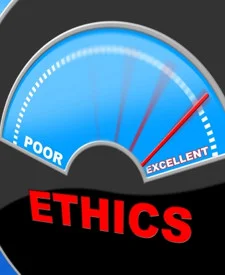
Medical ethics are healthier than business ethics

ethics_meter

Compared to most others in society, physicians endorse, and are held to, higher ethical standards.  (To illustrate, here are ethical codes from the AMA and the World Medical Association.)  High standards apply to professionals in other fields as well, especially fiduciaries such as attorneys, accountants, schoolteachers, and judges.  But standards of medical ethics may be among the most stringent.  We put patient welfare first, and anything that interferes with this primary aim, particularly personal gain, is deemed a conflict of interest (COI).  For example, it is legitimate to make money as a physician, i.e., to earn a living, but not in any way that detracts from patient welfare.  These are not black and white distinctions, however, and line-drawing controversies abound.  Offering unneeded treatment solely to boost income is always unethical.  But what about limiting one's practice in lucrative or otherwise pleasant ways: orthopedic surgeons practicing in ski towns, plastic surgeons who only do cosmetic surgery?  What about choosing a more lucrative specialty in the first place?  Accepting only certain types of insurance, or none at all?  Charging for missed or late-cancelled sessions?  Without attempting to resolve any of these examples here, it's noteworthy how much concern is voiced, and ink spilled, over how physicians practice.  To completely escape controversy, we'd have to take a vow of poverty and offer our services for free.

In contrast, many other businesses that affect health do not share the physician's ethics.  Precise line-drawing plainly doesn't apply.  Beverage companies peddle diabetes along with refreshment, supplements come adorned with dubious health claims. Snack food can be unhealthy.  Manufacturers and retailers of exercise equipment need not refer customers to more suitable products from competitors.   One can even argue that new cars, not to mention video games, movies, and many other products, discourage people from exercising.  "Patient welfare" simply isn't a priority for most firms — they aren't dealing with patients.  There is no general code of business ethics that makes health its primary aim.  Thus, in extreme cases the government — we the people — step in, by limiting tobacco and alcohol ads for example, or by inspecting meat.  This is one reason we have government: to set priorities, including ethical priorities, that an ungoverned free market cannot or will not.

Some firms do explicitly deal with patients, yet still do not share the physician's ethical standards.  Insurance companies run feel-good ads that obscure their cost-containment mandate.  Medical corporations attract customers or subscribers who are "covered lives" as opposed to individual patients.  Pharmaceutical companies entice the public with all the irrational tricks used to sell other products, then tack on "ask your doctor" to absolve themselves of any medical responsibility.  Pharmacy benefit managers (PBMs) can disallow a physician's prescription wholly on the basis of cost, and without taking medical responsibility.  These are all huge "conflicts of interest" from a physician's point of view. But COI doesn't apply the same way to entities with less stringent professional ethics, where the primary aim is profit, not health.

This makes our burden harder. For the most part, it isn't up to pharmaceutical companies to avoid biasing doctors with their promotional efforts. It's up to us.  Moreover, it's up to us to counter unhealthy biases instilled in the public, like the willingness to use an antipsychotic with significant side-effects to treat routine depression.  Likewise, as long as insurers and PBMs are corporations, no one will compel them through moral persuasion or ethical codes to sideline their economic interests. It's not a conflict for a business to maximize return for its shareholders; it's the main reason they exist. Indeed, too much concern for patient welfare might be criticized, e.g., at a shareholder meeting, as a COI that impedes this primary aim.

Doctors are held to standards that would be absurd in virtually any other business. Historically, these higher ethical standards gave us a special status in society, and earned our patients' trust. The erosion of this special status, and of patient trust, is both a cause and an effect of a health care environment with lower, more businesslike, ethical standards.  The accelerating corporatization of American medicine replaces traditional medical ethics with the looser standard of business ethics.  MD decisions are now vetoed by MBAs.  As a result, patients may see us as replaceable technicians in a corporate infrastructure, and lose the benefits of a personal physician.  In parallel, physicians who are viewed by their patients and employers as mere cogs in the wheel of a large system are more apt to relax their own high ethical standards.  I fear for both our profession and the public as this vicious cycle continues.

While we doctors are busy maintaining our ethics and watching out for COI, other "stakeholders" in health care operate under fewer ethical constraints and enjoy greater profits, often directly at our expense.  It can be maddening, yet physicians have no unified voice to defend ourselves and our work.  Proposed solutions are inescapably political, and polarize us along deeply divided political lines, left versus right.  Ultimately, though, traditional medical ethics and public welfare are on the same side.  Doctors exist to help individual patients — and we will all be individual patients someday.  The looming challenge is whether we can put our internecine struggles aside long enough to save ourselves, our families, and our neighbors.

Image courtesy of Stuart Miles at FreeDigitalPhotos.net

Behavioral science versus moral judgment

General George S Patton

George S. Patton, Jr. commanded the Seventh United States Army, and later the Third Army, in the European Theater of World War II.  General Patton, a brilliant strategist as well as larger-than-life fount of harsh words and strong opinions, was also infamous for confronting two soldiers diagnosed with "combat fatigue" — now known as post-traumatic stress disorder, or PTSD — in Sicily in August of 1943.  (One such incident was depicted in the classic 1970 film "Patton" starring George C. Scott.)  Patton called the men cowards, slapped their faces, threatened to shoot one on the spot, and angrily ordered them back to the front lines.  He directed his officers to discipline any soldier making similar complaints.  Patton's commanding officer, General Eisenhower, firmly condemned the incidents and insisted that Patton apologize.  Patton did so reluctantly, always maintaining that combat fatigue was a pretext for "cowardice in the face of the enemy." Seventy years have passed, yet as a society we still feel the tension between moral approval or disapproval on the one hand, and value-neutral scientific or psychological description on the other.  Cowardice is a character flaw, a moral lapse, a weakness.  PTSD, in contrast, is a syndrome that afflicts the virtuous and the vile alike.  We similarly declare violent criminals evil — unless they are judged insane, in which case our moral condemnation suddenly feels misplaced.  Likewise, a student who is lazy or careless needs to shape up to avoid our scorn; a student with ADHD, in contrast, is a victim, not a bad person.

Personality descriptors — brave, cowardly, rebellious, compliant, curious, lazy, perceptive, criminal, and many more — feel incompatible with knowledge of our minds and brains.  It seems the more we explain the roots of human behavior, the less we can pass moral judgment on it.  It doesn't matter if the explanation is biological (e.g., brain tumor, febrile delirium, seizure) or psychological (e.g., PTSD, childhood abuse, "raised that way").  However, perhaps because we feel we know our own minds best, it does seem to matter if we are accounting for ourselves versus others.  We usually explain our own behavior in terms of value-neutral external contingencies — I'm late because I had a lot to do today, not because I'm unreliable — and more apt to tar others with a personality judgment such as "unreliable."  This finding, the Fundamental Attribution Error, has been a staple of social psychology research for decades.

Will we eventually replace moral judgments of others with medical or psychological explanations that lack a blaming or praising tone?  It appears our inclination to judge others will not pass quietly.  Much of the rancor between the political Left and Right concerns the applicability of moral language.  Are felons bad people, or merely raised the wrong way?  Are the poor lazy and entitled, or trapped in poverty by circumstance?  Was General Patton disciplining cowards who were shirking their duty, or was he verbally and physically abusing soldiers who had already been victimized?

The Left and Right disagree over where to draw the line.  But no matter how far we progress in our brain and behavioral sciences, we will still want to voice judgments of others — and negative judgments seem the more compelling.  Humans are notoriously inventive in the use of language to denigrate.  Originally neutral clinical terms like "idiot" and "moron" (and "retarded" and "deluded" and many more) eventually became terms of derision.  Euphemisms like "juvenile delinquent" didn't stay euphemistic for long.  While it may blunt the sharpness of our  scorn in the short term, "politically correct" language won't change this aspect of human nature in any lasting way.

Even logic doesn't stop us.  For example, terrorists are routinely called cowards in public discourse, although it isn't clear why.  Many terrorists voluntarily die in their efforts, an act considered heroic, or at least brave, in other contexts.  They often attack civilian rather than military targets.  But we did that in WWII, and we weren't cowards.  They use guile, sneak onto planes, employ distraction and misdirection — like our "cowardly" Special Forces do.  The point is, we find terrorists despicable, but that isn't a strong enough putdown.  If we didn't call them cowards, we'd have to call them something else to humiliate them.  Mama's boys?

Humans are a funny species.  Uniquely striving for intellectual understanding, yet not so far from the other beasts who purr or growl or screech their approval or protest.  Balancing the aims of morality and science is the stuff of constant, and perhaps endless, political debate.  Ultimately it's irresolvable, yet we do our best to pay homage both to our hearts and our heads.

Review of "Century of the Self" (BBC documentary)

Edward Bernays It may have been a patient (I can't recall) who suggested I search online for the 2002 BBC documentary by Adam Curtis called Century of the Self.  It turns out the video is freely available at several sites; the full four-hour documentary can be viewed or downloaded here, or each of the hour-long installments here.  In briefest outline, Century of the Self advances the thesis that Freud's views of the unconscious set the stage for corporations, and later politicians, to market to our unconscious fears and desires.  It's gripping, it explains a lot, and it reminds me of The Matrix in the way it portrays an ugly dystopian truth hidden behind bland normality.  Except Century of the Self is real, not science fiction.

One reviewer offers: "There are very few movies I wish I could force my friends to watch, that I feel encapsulate a feeling that I've had but have been unable to articulate."  Indeed, Century of the Self ties together several observations I myself have made over the years about corporate marketing — and then it goes much further, placing those observations in a broad context.  For example, in my youth I found it odd that any products at all could be marketed to hippies, those bastions of non-materialism.  Yet by the early 1970s the signature unkempt long hair became a "style" featured in fashion magazines and offered in hair salons, and blowdryers were widely sold to cater to this new look.  Less than a decade later, punk rockers pierced their clothes with rows of safety pins, and it wasn't long before Macy's sold brand new clothes with safety pins already inserted.  Goth, grunge, hip-hop, or hipster, it doesn't matter.  Products will be sold.  As the Borg say: "You will be assimilated.  Resistance is futile."

I noticed something similar at the other end of the materialism continuum as well.  By the 1980s, expensive, formerly niche products were being avidly marketed to ordinary consumers.  Regular cooks bought restaurant-grade pots and pans, average shutterbugs purchased advanced cameras, families who never left the suburbs drove SUVs that could go off-road and up mountainsides.  What motivated people to spend their hard-earned money on features they'd never use and quality they'd never fully appreciate?  Again, it was hard to escape the conclusion that corporations sold self-image and emotional aspirations, not rational goods and services.

I'm old enough to remember when "lifestyle" was first popularized as a sales term, and when pitches aimed at self-image were still a little ham-handed and obvious (e.g., "What sort of man reads Playboy?").  Now we fail to notice that it is literally impossible to sell a new car, or prescription medications to the public, with an appeal to rationality. No one even tries.  Back in the mid-1970s it was novel and slightly jarring when gasoline companies ran ads not (directly) to sell gas, but to improve their corporate image.  We've come to accept that as routine nearly 40 years later.

It hasn't always been so.  Century of the Self shows how advertising once aimed to influence rational choice.  This gave way in the early 20th century to advertising aimed to connect feelings with a product.  Amazingly enough, at the root of this change was Sigmund Freud's nephew, Edward Bernays.  Bernays, an American propagandist in WWI, applied his wartime experience and his uncle's theories of the unconscious to peacetime commerce.  He invented the field of public relations, popularized press releases and product tie-ins, and changed public opinion about matters ranging from women smoking to the use of paper cups — all to increase sales.  Viewing politics as just another product to sell, Bernays also helped Calvin Coolidge stage one of the first overt media acts for a president, and helped engineer the 1954 coup in Guatemala on behalf of his client the United Fruit Company, by painting their democratically elected leader as communist.

This and more happens in just the first hour of the documentary, titled "Happiness Machines."  The second hour, the weakest in my view, is called "The Engineering of Consent" and focuses on the ascendancy of psychoanalysis and Anna Freud's consolidation of power.  The point here is that the unconscious was seen as a dangerous menace that needed to be kept under lock and key.  Rational choice, especially by crowds, was unreliable under its influence, so "guidance from above" (in Bernays' words) was needed from political leaders and corporations for the public good.  The conformity and mass-marketing of the 1950s reflects this view of a public that cannot be trusted to think for itself.  The pendulum swings the other way in the third and best installment, "There is a Policeman Inside All Our Heads [and] He Must be Destroyed."  By the 1960s the human potential movement urged the expression of impulses instead of their repression.  Business was eager to help.  By marketing products as a means of self-expression, business turned from channeling public impulses to pandering to them.  There is a fascinating discussion in the film about political activism being co-opted in this process: making the world a better place gave way to making oneself better in ways that, not coincidentally, required buying more goods and services.  The final segment, called "Eight People Sipping Wine in Kettering," follows this impulse-pandering into politics.  Instead of political leadership, we now have politics led by focus groups.  The public gets what it asks for (V-chips and populist slogans), not what it needs (healthcare and infrastructure improvements).

Freud himself is treated ambiguously in the documentary.  Although he benefitted by his nephew's promotion of his writing, one gathers he was uncomfortable with commercial exploitation of his ideas.  Enigmatically, the final camera shot zooms in on Freud's tombstone.  Perhaps we are to imagine him turning over in his grave.

How can democracy work best, given that our choices are inevitably swayed by irrational unconscious forces?  Curtis isn't explicit, but implies that treating people as rational tends to make them moreso.  Even as a firm believer in the dynamic unconscious, I find this a hopeful point of view.  It also occurs to me that it is a researchable hypothesis, and that such research may in some measure counterbalance commercial and political profiteering from research on unconscious influence.  The ethical implications of powerful social institutions exerting covert influence are only telegraphed in the documentary; they deserve a detailed analysis in their own right.

Century of the Self has engaging interviews, rare archival footage, a sweeping view of recent history, and, alas, somewhat irritating music.  It was reviewed quite positively when it came out, and despite being over ten years old, still has a great deal to offer.  I don't wish to force anyone to watch it, but I do highly recommend it.

How to promote nonviolence — (2) Necessary elements

morihei-ueshibaIn my last post, I outlined the fundamental problem facing advocates of nonviolence: Despite nearly universal conceptual agreement with this goal, human psychology conspires to make peace elusive and strife apparently unavoidable.  Our emotions trump our rationality, biasing assessments of real-world evidence and leading to post-hoc justification of whatever our "gut" feels.  Unfortunately, and rightly or wrongly, our gut feels scared or mistreated much of the time.  Violence is often the result, whether construed as self-defense or justified retribution.  This occurs with individuals, groups, and nations, and behaviorally ranges from brief verbal expressions of contempt to weapons of mass destruction and genocide. Gut reactions cannot be overcome by rational argument alone.  "Fight or flight" responses to threat, and urges to inflict retribution or punishment, start at the emotional level.  Since it is unrealistic to hope for a world without emotional triggers — without perceived threats that "demand" violent self-defense, or injustice that "demands" violent retribution — those who advocate nonviolence must accept the reality of emotional provocation.  Another reality is that even those who endorse a nonviolent philosophy are saddled with the same emotional reactivity as everyone else.   Given these constraints, how can nonviolence be promoted an emotional level?

Safety

It has often been said that our physiologic response to stress serves us well in situations for which it was originally designed, e.g., an attack by a wild animal, but that it is misplaced in our modern world of "attacks" by time deadlines, career pressures, and miscommunication by loved ones.  Autonomic stress responses — increased pulse and blood pressure, outpouring of stress hormones, faster reaction time —  may save our lives in dire situations, but only hurt and exhaust us when activated chronically and without purpose.  Many effective ways of managing unhealthy stress do so by enhancing feelings of safety and relaxation, emotions that are incompatible with the stress response.

In many respects, violence is similar.  With rare exceptions, it is a reaction to a perceived threat.  It may be said that violence serves us in situations "for which it was originally designed": self-defense against a warring enemy or a criminal intent on killing us.  Yet it only hurts and exhausts us individually and as a species when activated chronically.  Enhancing feelings of safety and relaxation helps us be less violent and more peaceful; conversely, a heightened sense of danger and tension promotes violence.  While dangerous threats exist in the real world, they trigger violence emotionally, not rationally.  Being cut off in traffic may constitute a real physical threat, but our urge to respond with verbal or physical violence arises from a complex stew of imagined contempt by the other, anonymity in our vehicle, an assessment of the likelihood of further escalation, how much we feel they "deserve" it, and similar factors.  Emotional safety is complex and not easily assured.  Yet it is a necessary element in our closest relationships, in our work, in our communities, and on the world stage.  When it is lacking, violence often results.

Humanization of the Other

This is perhaps better stated in the negative: It takes dehumanization to commit violence.  From schoolyard putdowns to racial epithets to "the enemy" in wartime, our thoughts and language serve to make emotionally driven violence acceptable.  It is hard to treat another person as expendable or deserving to suffer while imagining his or her grieving parents or children — so we take pains not to.  Seeing each other as cherished, capable of suffering, and harboring a unique view of the world — in a word, human — is another necessary element for promoting nonviolence.  Without it, people are means to an end, not ends in themselves.

Role Models

Depicted with the prior post was Mahatma Gandhi, the first to apply nonviolent principles to politics on a large scale.  Gandhi's nonviolent philosophy, which he termed satyagraha, would likely have had little influence without his personal actions and role-modeling that led to political change in India and elsewhere.  Gandhi modeled nonviolence working.  Role models such as Gandhi, Martin Luther King, Jr., and Jesus of Nazareth show others a peaceful path by modeling not only behavior, but also emotion: the courage to act according to ideals, without succumbing to fear that might otherwise justify violence.

A similar role model is depicted with this post.  Morihei Ueshiba (often called O Sensei, or Great Teacher) founded the Japanese martial art of aikido.  Based on earlier violent styles, aikido aims to neutralize violent attack while leaving the attacker unharmed.  Aikido's core principle of harmonizing one's physical and spiritual energy with the attacker's would be little more than esoteric philosophy if not for its practical application.  As Gandhi did in politics, Ueshiba modeled nonviolence working, in this case against literal physical attack, and in a manner that can be learned and practiced by others.

Early Learning

Patterns of emotional reactivity are established in early childhood.  While a propensity to violence may be inborn, nonviolent alternatives can be introduced quite early as well.  A society dedicated to nonviolence would teach this in preschool, introducing more sophisticated and challenging scenarios in grade school and beyond.  Such a curriculum would not pretend that the world is a peaceful place.  Maintaining a nonviolent stance in a world that seems to demand the opposite is a lifelong challenge.  All the more reason to start confronting this challenge as soon as possible, ideally before personality is codified and harder to influence.

Practice

It's one thing to aspire to an ideal, quite another to behave accordingly.  There is no substitute for practice, "walking the walk" as well as "talking the talk."  Emotion may trump rationality, but intentional action (and well-chosen cognitions) can shape emotion.  Practicing peaceful conflict resolution may occur in daily life, of course.  But in addition, dedicated training or exercises may be necessary elements.  For example, disciplined participation in nonviolent political action, or in aikido training, may instill peaceful "reflexes" in a way that merely hearing or reading about these practices cannot.

In this post I outlined ways of promoting nonviolence, taking into account emotional and worldly realities.  This list is very general and far from exhaustive, and is offered in the spirit of collaboration and discussion.  Instead of dividing ourselves by tactics — more guns laws or fewer? death penalty or not? — common ground seems a better place to start.  Most of us seek peace, yet most of us share emotions that feed violence.  This makes a peaceful world an elusive yet worthy goal we can work toward together.

How to promote nonviolence — (1) The problem

95e39/huch/1887/3Prompted by the Sandy Hook shootings and Boston Marathon bombings, a bumper crop of articles about our violent society has sprouted in recent weeks.  I was particularly drawn to this opinion piece in the New York Times.  Author Todd May, a Clemson University professor of Humanities, articulates well the crucial underpinning of a nonviolent world view: "the recognition of others as fellow human beings, even when they are our adversaries."  Drawing on the philosophy of Immanuel Kant, who said that the core of morality lay in treating others not simply as means but also as ends in themselves, May argues that the key to a nonviolent society is "to see our fellow human beings as precisely that:  fellows.  They need not be friends, but they must be counted as worthy of our respect, bearers of dignity in their own right." May is surely correct about this.  A morality based in respect for others, and in recognition of our duties and obligations to others, underlies most of the defensible arguments favoring nonviolence.  (The major alternative, a utilitarian morality based on outcomes and consequences, will forever argue that the ends justify the means, even if the means are violent.)  The Golden Rule "do unto others..." and biblical admonitions to "love thy neighbor as thyself" are based on this type of reasoning, called Kantian or deontological.

At the philosophical level, then, the challenge is to convince ourselves and each other that deontological respect for our fellow human beings is itself a concept worthy of respect.  To put it mildly, this is not so easy.  Everyone from Confucius to Jesus to Gandhi has tried.  Yet "peace on earth, goodwill to men" still sounds like a pipe dream, lovely words that have no bearing on real life.  Even the many of us who claim to accept this precept often act otherwise.  Why does this perspective, favored by virtually all world religions — as well as secular humanists — and argued most compellingly by our greatest thinkers, nonetheless fail to gain traction?  The answer to this central question of human existence: psychology.

Sadly, we humans don't always behave sensibly.  Our feelings often precede and even dictate our thoughts.  This was first brought home to me when, as a college student witnessing a political protest, I suddenly realized that the emotional fervor expressed by both sides had very little to do with thinking the issue through.  Indeed, it seemed people who understood the subject the least had the strongest feelings about it, pro or con.  Moreover, it appeared that people become emotionally invested first, and only later bolster their positions with post-hoc reasoning.  Around the same time, I helped with a well-known psychology experiment on confirmation bias, our human tendency to grant greater weight to evidence that supports what we already believe.  In the experiment, subjects who already had strong opinions pro or con about the death penalty reviewed exactly balanced "evidence" — I should know, I fabricated it — and reached opposite conclusions.  That is, both sides felt more justified in their prior belief by weighing more heavily that portion of the evidence that agreed with their existing position.  Those already in favor of the death penalty became more in favor, those already opposed became more opposed.  Both the political rally and this experiment figured centrally in my decision to pursue a mental health career.  Here was proof that people simply aren't rational — and that's fascinating.

While fascinating, this reality bodes poorly for reasoned arguments aimed to influence others.  As a society we argue endlessly over social issues:  the role of government, whether private gun ownership increases or decreases one's safety, the legitimacy of gay marriage, how we should treat undocumented immigrants.  Selected (i.e., biased) facts, statistics, and images are lobbed back and forth.  Those who already agree with a particular bias applaud; those who are opposed become annoyed and counter with facts, statistics, and images of their own.  For the most part, everyone feels vindicated by their confirmation bias.  Very few minds are changed.

Nonviolence is an especially poignant case.  Nearly everyone claims to be on the side of discouraging and decreasing violence, yet there is vehement disagreement over how to achieve this.   Moral directives to "do unto others" or "love thy neighbor" are dismissed as naive.  Here in the real world it's "peace through strength," "the best defense is a strong offense," and "a pacifist is someone who hasn't been mugged yet."  Violence is treated emotionally as axiomatic, a given, with post-hoc justification that "they deserve it" or "they started it," or that committing violence now prevents more later.  It is a necessary evil, an entrenched part of the human condition.

In part two, I will pick up from here.  Given that moral reasoning alone rarely changes anything or anybody in the real world, what can?  Is there a meaningful way to promote nonviolence?